
Earth Science Week Classroom Activities
From the Soil Comes the Spoils: Discovering Mineable Critical Minerals Beneath Our Feet
Activity Source: Soil Science Society of America
Grade Levels: 6-9
Background
Every soil on Earth is made up of mineral particles that originated from the weathering and breakdown of rocks. These minerals include quartz, feldspar, mica, and various metal oxides (including iron and manganese) and give soil its color, texture, and chemical properties (see Figure below). Many of the same mineral families found in soil are the source of critical minerals: resources essential to modern technology, from the lithium in batteries to the rare earth elements in smartphones. In this activity, students will separate and examine the mineral components of soil to begin to evaluate the hidden geological (and thus pedological [the study of soil formation]) wealth beneath their feet and explore how soil connects to the critical minerals that power modern society.
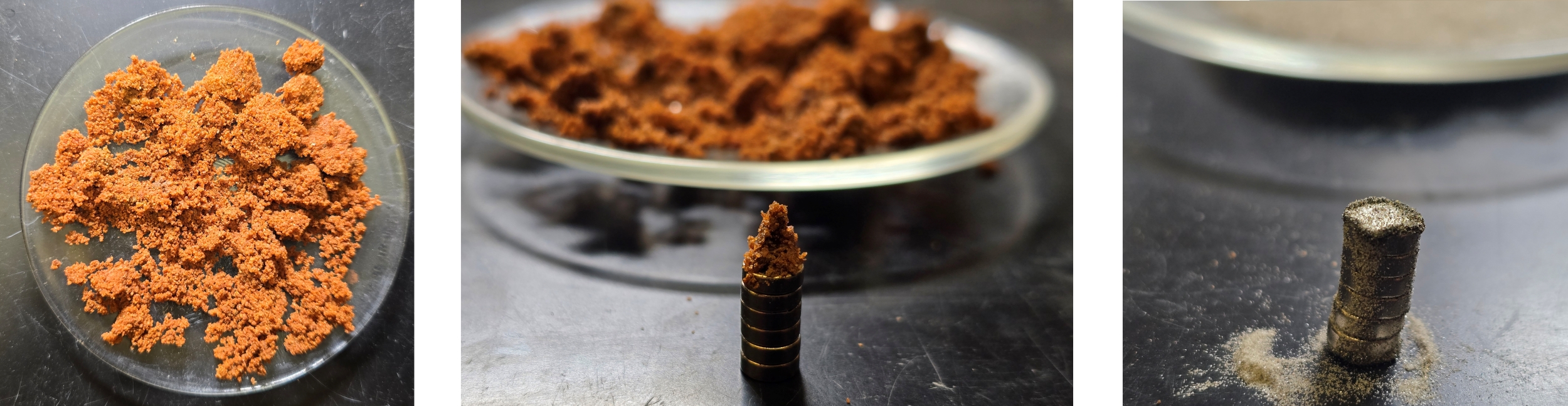 The figure shows (left) a red soil determined to be (middle) high in iron as much of it sticks to a magnet, while (right) the coarse sand has less magnetic minerals (grey filings on the magnets) since it is mostly marine in origin and so has mostly quartz and crushed shells (tan sediment next to the magnets).
Image credit: Soil Science Soiety of America
The figure shows (left) a red soil determined to be (middle) high in iron as much of it sticks to a magnet, while (right) the coarse sand has less magnetic minerals (grey filings on the magnets) since it is mostly marine in origin and so has mostly quartz and crushed shells (tan sediment next to the magnets).
Image credit: Soil Science Soiety of America
Materials
- Dry soil sample (2 cups per group; ideally from 2-3+ different locations)
- Clear jars with lids (1 per group) (8-32 oz)
- Water
- Strong magnets (bar or neodymium) – not typical refrigerator magnets
- Small plastic bags and paper plates
- Hand lens or magnifying glass
- Fine-mesh kitchen sieve or mesh strainer
- White paper
- Ruler
Procedure:
- Collect and Observe. Place one cup of dry soil on white paper. Use a hand lens and observe the sample closely. Record what you see: colors, grain sizes, shiny or dull particles, and any organic material (roots, leaves, insects). Sketch or describe at least three different-looking particles.
- Magnetic Mineral Separation. Wrap a strong magnet in a small plastic bag. Slowly pass the magnet through the soil sample, hovering just above the soil. Gently remove the bag from the magnet over a paper plate to release any attracted particles. Observe these particles with a hand lens. These are likely iron-bearing minerals such as magnetite (a natural source of iron, which is essential for steel production and many technologies)
- Settle and Separate. Place a half cup of the remaining soil into a clear jar or cup. Fill it about three-quarters of the way with water, seal or cover it and shake vigorously for 30 seconds. Set the jar on a flat surface and observe it over the next 5-10 minutes. Sand (heavy minerals like quartz) settles first, followed by silt, then clay. Organic matter floats. Measure and record the thickness of each layer with a ruler.
- Sieve for Treasures. Using a fine-mesh sieve, separate the coarser particles from the remaining dry soil. Examine the material caught in the sieve with a hand lens. Look for quartz grains (clear or white, glassy), feldspar (pinkish or white, blocky), and dark grains (possibly hornblende or mica). Sort and group similar-looking grains on white paper.
- Connect to Critical Minerals. Using the reference table below, match the minerals you identified in your soil to their related critical mineral uses. Discuss with your group: Which everyday technologies depend on minerals that started in rock and ended up in soil?
| Mineral in Soil | How to Spot It | Related Critical Mineral(s) | Mineral Uses |
|---|---|---|---|
| Magnetite (iron oxide) | Black, attracted to magnet | Cobalt, nickel, and manganese (typically found in tandem with iron oxide) | Steel, batteries, electronics |
| Quartz | Clear/white, glassy, hard | Silicon | Computer chips, solar panels |
| Feldspar | Pink/white, blocky grains | Aluminum (from bauxite/clays) | Aircraft, packaging, vehicles |
| Mica | Shiny and flaky sheets | Lithium (in Li-bearing micas) | Rechargeable batteries, EVs |
| Clay Minerals | Very fine, stays suspended in water | Rare earth elements (adsorbed- held by clay minerals) | Magnets, wind turbines, phones |
Analysis
- Based on your settling jar, estimate the percentage of sand, silt, and clay in your soil sample. Which layer was thickest? How might the mineral composition of that layer differ from the others?
- Did your magnet pick up any particles? If so, describe them. Iron-bearing minerals like magnetite are connected to critical minerals such as cobalt and manganese. Why might it matter where and how we obtain these minerals?
- Soil forms from the weathering of rocks over hundreds to thousands of years. If a region’s bedrock is rich in a critical mineral, how might that affect both the soil and the local economy? Give an example.
Suggested Responses
Click here to view ideas that students might include in their analysis.
- Responses will vary depending on the soil used in this activity; however, students will likely recognize that there are more (and varied) minerals discernable in the sand layer for step 3.
- Student responses may mention that the grains are dark and irregularly shaped. They may need assistance in recognizing that for iron mining to be profitable and beneficial, the iron needs to be concentrated.
- Student responses may vary; however, they should mention that soil is formed by erosion, so any critical minerals that are easily eroded likely were removed from the area as the parent rock broke down. If the soil does have a concentrated amount of a critical mineral, it may be a challenge to remove the minerals from the soil as opposed to obtaining the minerals from mined rock (ore).
Further Steps / Extensions
FURTHER STEPS / EXTENSIONS
- Compare soils from different locations. Repeat the procedure with soil from different areas such as a garden, a riverbank, and a construction site (even from different states if you can!). You could even separate soils based on how deeply they’re buried. How do the mineral components differ? What might explain the differences?
- Map your critical minerals. Use the USGS Mineral Resources Online Spatial Data to explore what minerals are found in your state’s bedrock and soils.
- the supply chain. Choose one critical mineral from the reference table. Research where it is mined globally, how it reaches consumers, and what environmental or social issues are associated with its extraction.
- Explore soil mineralogy online. Visit the SSSA Soils 4 Teachers Mineralogy page for additional background on minerals in soil.
- USGS Critical Minerals List. Review the full list of critical minerals and identify which ones might be found in soils near you.
Next Generation Sceince Standards Connections
- SEP: Planning and Carrying Out Investigations
- DCI: ESS3.A: Natural Resources
- CCC: Scale, Proportion, and Quantity