
Earth Science Week Classroom Activities
From Puddle to Mineral
Activity Source: Geological Soceity of America
Grade Levels: 5-10
Introduction*
Not every mineral is dug out of solid rock. Some of the most important minerals in products, such as lithium in phone and car batteries, or the borax used in electronics, glass, and detergents, are actually harvested from brine, a solution of water containing dissolved minerals. When brine sits in shallow pools and the water evaporates in the sun, mineral deposits are left behind. Mining companies can use this exact process on a large scale by having evaporation ponds cut into the world’s largest salt flats (see Figure).
In this activity, students will mimic the process of extracting minerals from a brine on a small scale by growing their own crystals from a mineral-rich solution, and then testing how changing the concentration of the solution or altering other factors about the environment affect evaporation rates and mineral deposition.
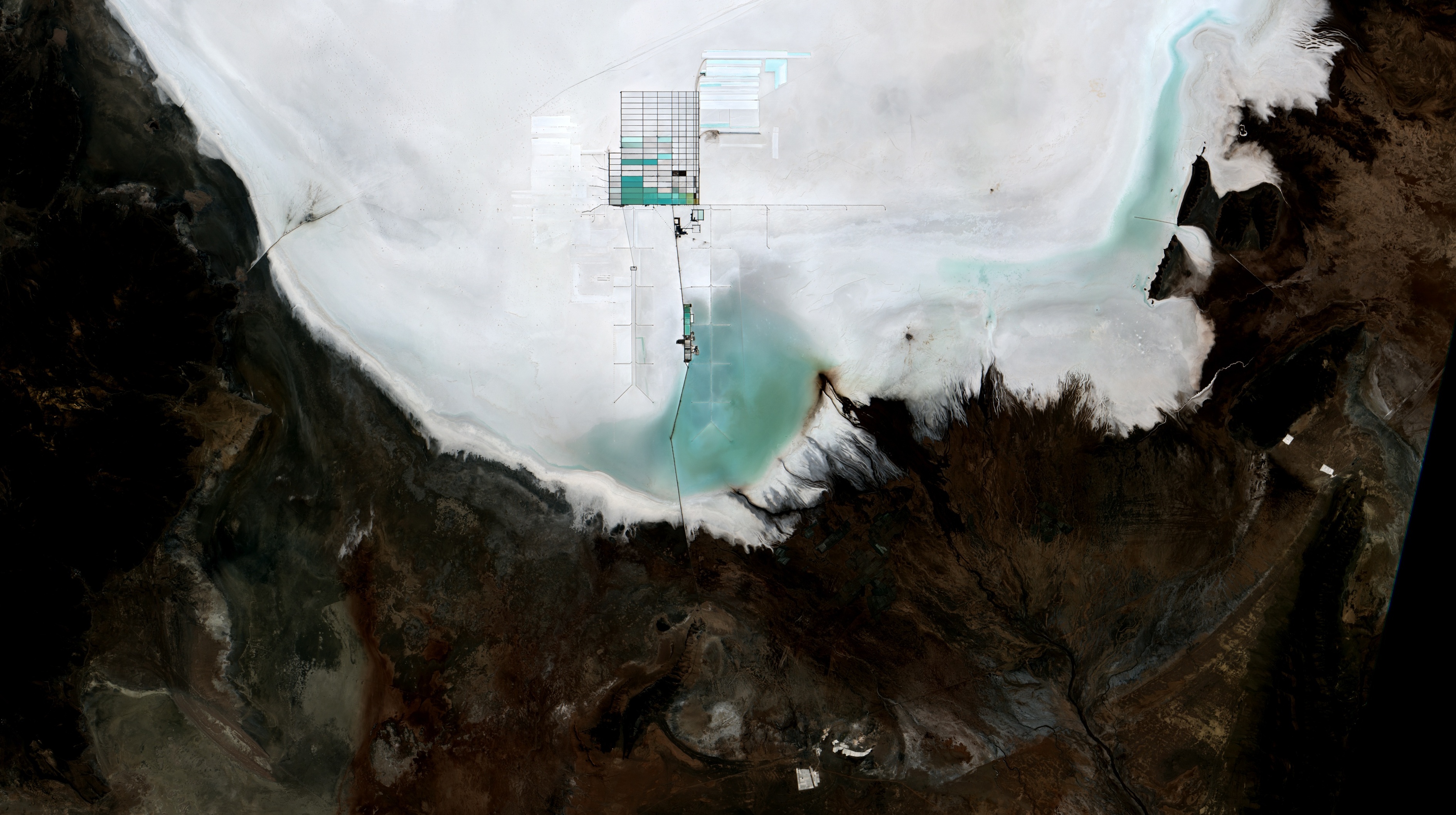
Figure 1. An overhead view of Bolivia’s Salar de Uyuni mine. The rectangles represent lithium evaporation ponds managed by mining engineers. Credit: Oton Barros, CC BY-SA 2.0
Materials
- Epsom salt (magnesium sulfate)**
- Warm water
- 3-4 clear, shallow containers (e.g., Petri dishes)
- Spoon
- Labels or masking tape and a marker
- Small rock or piece of unglazed terracotta (optional)
- Hand lens or magnifying glass
- A warm, sunny area, or heat lamp
**Safety Note: Epsom water is safe to handle, but you should wash your hands thoroughly after handling. Epsom salt is not safe to consume.
Procedure
- Making the brine and control setup:
- Mix Epsom salt into warm water, stirring until no more salt will dissolve. This is called a saturated solution because it cannot dissolve any more salt at this temperature.
- Label a shallow dish with your name or your group name. Then, place it in a warm, sunny area where it will not be disturbed.
- Pour the brine into the shallow dish located, and allow this control solution to sit until the water has evaporated. make note of how long it takes for the solution to evaporate.
- Make observations of the solution daily. You may want to use a hand lens to get a better view of the crystals. You may also want to take pictures or make sketches of the dish over time.
- Choosing a variable to test:
- Brainstorm a list of factors you could change about the control setup to test different variables.
- Remember that your brine represents a pool on a salt flat at a mining site. Discuss with your group or class which of the variables you came up with could represent a real-world factor that could affect an actual brine pool. For example, you could use a larger dish to represent a mine with a larger brine pool.
- Choose which variable you most want to test. Get approval from your teacher and obtain additional materials, as needed, to test your variable.
- Make a prediction on how your variable will affect mineral deposition (crystal growth) compared to the control.
- Repeat Steps 1b-d to set up your test dish. You may want to add your variable to your dish label.
Analysis
- Which container produced the most crystals? The least? The largest crystals?
- If other groups tested different variables, make observations of their test dishes or share results as a class.
- How did your prediction compare to your results? Describe how your test dish compares to your control.
- How could your results help inform the process of mining lithium or borax from brines? Describe your results in terms of relating it to brine pools at mines. Include considerations of how your model is similar to and different from real-world brine pools.
Extensions
- Compare the shape of your Epsom salt crystals to images of lithium (the purple areas on this image) and borax crystals (clear crystals on this image). How do they compare?
- Look at a satellite image or map of a brine pool (screenshot of a map, or use a map program to search for Salar de Uyuni, Bolivia to zoom in to different scales).
- Use the scale to determine the size (length and width) of the brine pool or pools.
- Most lithium brine pools are between 0.5 meters (1.5 feet) to 1.5 meters (5 feet) in depth. Use your measurements of length and width to calculate the potential volume range of one of the pools.


Next Generation Sceince Standards Connections
- SEP: Asking Questions and Defining Problems
- DCI: ESS3.A: Natural Resources
- CCC: Energy and Matter