Critical Minerals for a Thriving Society
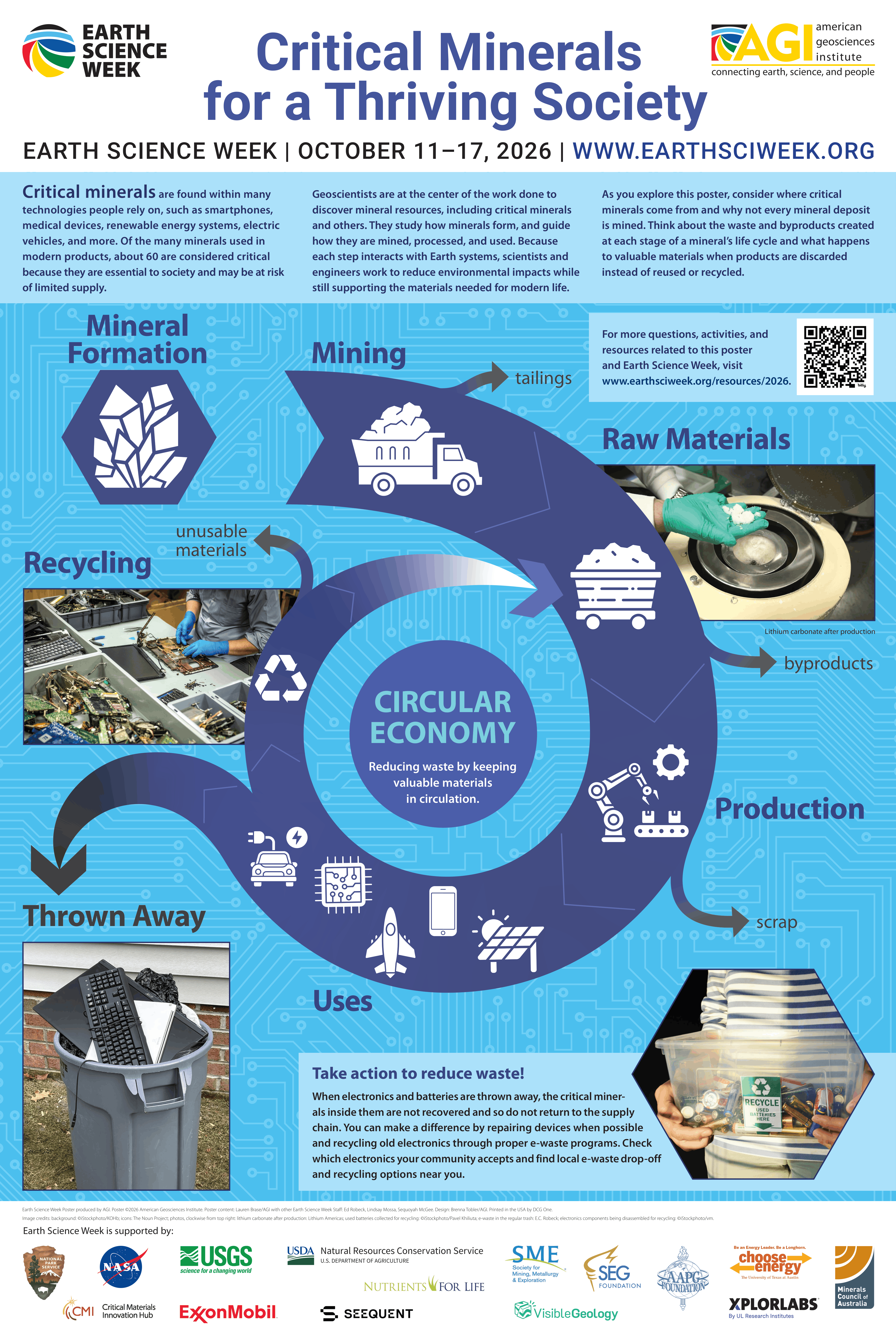
The theme for Earth Science Week 2026, “Critical Minerals for a Thriving Society,” invites you to explore the essential mineral resources that power modern technologies, strengthen infrastructure, support national security, and drive innovation. Understanding where these minerals come from, how they are responsibly developed and used, and how recycling and a circular economy can help conserve resources are key to building a more sustainable and resilient future.
Celebrate Earth Science Week (ESW) and discover how geoscience supports the responsible production, use, and stewardship of the critical minerals that shape our daily lives and the technologies of tomorrow.
Table of Contents:
- Earth Science Week Poster
- Geologic Map Day Poster: Examining Critical Minerals on Seward Peninsula
- 2026-2027 ESW Calendar Activities
- Additional ESW 2026 Resources
- 2026 ESW Webinars
- Get Involved in Earth Science Week
- Thank you to the 2026 ESW Sponsors
2026 Earth Science Week Poster
Learning Activities
- Choose one mineral from this critical minerals list, published by the USGS and Department of Interior. Research the stages of its life cycle and fill in where it is typically found, how it forms, how it is used, whether it can be recycled, and what challenges exist for recovering it from used products. Use this graphic organizer to share your research.
- Choose one stage of the critical mineral life cycle (formation, mining, processing, use, recycling, or disposal). Describe how it interacts with and/or affects Earth’s systems (geosphere, hydrosphere, atmosphere, and/or biosphere).
- It can be beneficial to keep valuable materials in circulation through a circular economy.
- Choose one product you have in your home and explain how repairing, reusing, remanufacturing, or recycling could extend its life and reduce the need for newly mined materials.
- What other actions can you take to help conserve critical mineral resources and support a circular economy?
- Consider careers that are related to critical minerals and a circular economy and select two to learn more about. Describe the career and how it relates to the life stages of minerals on the poster front.
- How does your community fit into the critical mineral life cycle?
- Research whether your city or state has known deposits of critical minerals, active mines, processing facilities, or e-waste recycling programs.
- Imagine geologists discover a new critical mineral deposit nearby where you live. Should the mineral deposit be developed into a mine? Explain your answer by considering how mining could affect the environment, local economy, nearby communities, and the need for critical minerals.
- Explore the UN Sustainable Development Goals. Which goals are most closely connected to critical minerals? Explain how critical minerals can both support and challenge progress toward those goals.
Geologic Map Day Poster
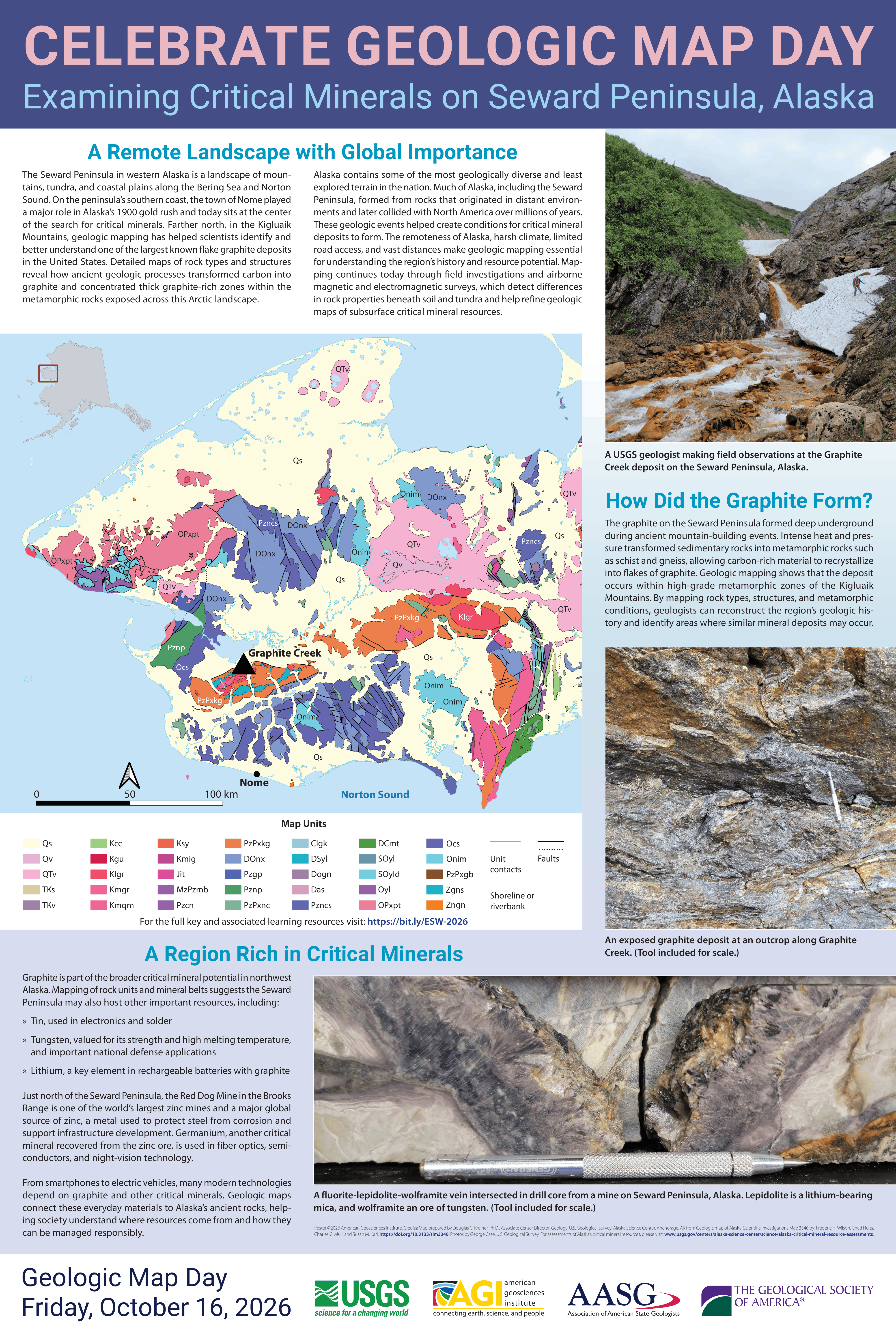
This year’s Geologic Map Day poster highlights the Seward Peninsula in western Alaska, where geologic mapping has helped scientists better understand the region’s potential for critical minerals, including the identification of one of the largest known flake graphite deposits in the United States. While Alaska contains some of the nation’s most geologically diverse terrain and abundant critical mineral resources, important deposits are found throughout the United States, making geologic mapping an essential tool for understanding where these resources occur and how they can be responsibly managed.
To explore Alaska’s geology in greater detail, including the complete statewide geologic map and map key used to create this poster, visit the Geologic map of Alaska.
You can also learn more about ongoing Alaska Critical Mineral Resource Assessments and how the USGS is evaluating the state’s potential for graphite, lithium, rare earth elements, tin, tungsten, and other critical minerals: Alaska Critical Mineral Resource Assessments.
Learning Activities
- Examine the geologic map of Seward Peninsula and the map key. Also, explore the interactive Geology of Alaska Map Viewer. Identify patterns, features, and questions you have about the map. Then use your observations to make claims about:
- The region’s geologic history. What evidence on the map suggests that the region has a complex geologic history?
- How the differences between the map units surrounding Graphite Creek and Nome might influence where graphite is found.
- Where other valuable mineral resources might be found. Support your ideas with evidence from the map and describe what additional information you would need to test your hypotheses.
- Imagine you’re a geologist creating this map.
- What observations would you need to collect in the field?
- Modern geologic maps combine field observations with airborne magnetic and electromagnetic surveys. Research one of these mapping methods and explain how it complements traditional field mapping.
- Use the National Cooperative Geologic Map Database to find a geologic map of your state, or if you live in the lower 48 states of the U.S., you can navigate to your area on the Cooperative National Geologic Map.
- Obtain a sample of graphite. Observe its color, streak, luster, hardness, and texture. How do these properties make graphite useful for products such as pencils, batteries, and lubricants?
- What might these similarities and differences suggest about the mineral resources that might be found in your state?
- The poster discusses one critical mineral, graphite.
- How does the geology of your region compare with the Seward Peninsula? What similarities and differences do you notice?
- Research where else graphite is found.
- Graphite has been used in pencils for hundreds of years, so why is it now considered a critical mineral? Research two modern technologies that rely on graphite, how the graphite helps these technologies function, and explain why demand has increased.
2026-2027 ESW Calendar Activities
- Spreading the Word About Critical Minerals, from the Mineralogical Society of America
- Mining the Data: Supply and Demand for Critical Minerals, from the American Association of Petroleum Geologists
- From the Soil Comes the spoils: Discovering Mineable Critical Minerals Beneath Our Feet, from the Soil Science Society of America
- Reading the Earth from the Air, from the American Geophysical Union
- How NASA Reads Minerals from Light, from the Nation Aeronautics and Space Administration
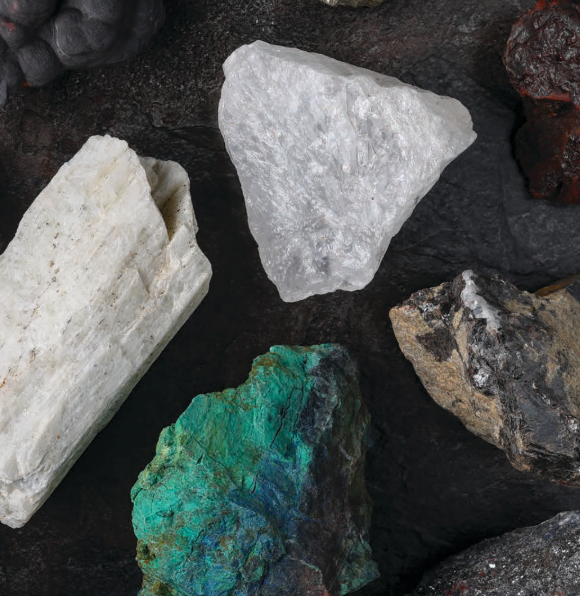
- Critical Minerals Search, from the Minerals Education Coalition
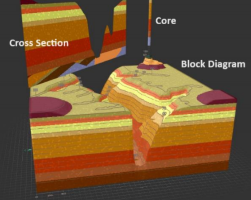
- 3D Models of Mineral and More!, from the Earth Science Information Partners and the Paleontological Research Institution
- Power Up with Critical Minerals, from the U.S. Geological Survey
- A Mineral Tour of National Parks, from the National Parks Service
- Traveling Back in Time through Seafloor Cores, from the Scientific Ocean Drilling Coordination Office
- Oil Behavior on Beach Sediment, from the National Oceanic and Atmospheric Administration
- From Puddle to Mineral, from the Geological Society of America
See the complete 2026-2027 ESW Calendar on the ESW Online Toolkit!
Additional ESW Resources


Do you have resources you would like to share with the K-12 community related to the 2026 Earth Science Week theme Critical Minerals for a Thriving Society? Please email us with “ESW 2026 Resource” as the subject line to info@earthsciweek.org
2026 ESW Webinars
The American Geosciences Institute is celebrating the 2026 ESW theme, “Critical Minerals for a Thriving Society” with a collection of webinars throughout Earth Science Week, all premiering at 1 PM ET on YouTube Live.
- Critical Minerals in a Circular Economy
- From Mine to Market: Minerals Critical to our Food
- Let’s talk: Critical Minerals, Sustainability and Energy
- Innovative Technologies for Critical Minerals Supplies
- Exploring Critical Minerals Through Place-Based Learning
Visit the ESW Webinars webpage to learn more about each webinar and register!
Get Involved in Earth Science Week
How can you get involved? Explore the links below and others on the Earth Science Week website to find a host of tools designed to make planning and attending events easy, fun, and rewarding! We have many resources to help you work with local geoscience professionals to engage young people and others in events that help everyone to consider their role in Earth science, innovation, and sustainability.
- Plan an Earth Science Week event
- Participate in Earth Science Week contests
- Watch the Earth Science Week webinar series
- Participate in focus days
- Learn more about how others have promoted events in the Earth Science Week Highlights Reports
2026 ESW Sponsors